A friend
When I was getting ready to move with my family from Poland to Tenerife, I rented a flat a few months in advance. It was going to stand empty for that time, so I asked a friend whether he wouldn't like to live on the island for a while. He agreed without hesitation.
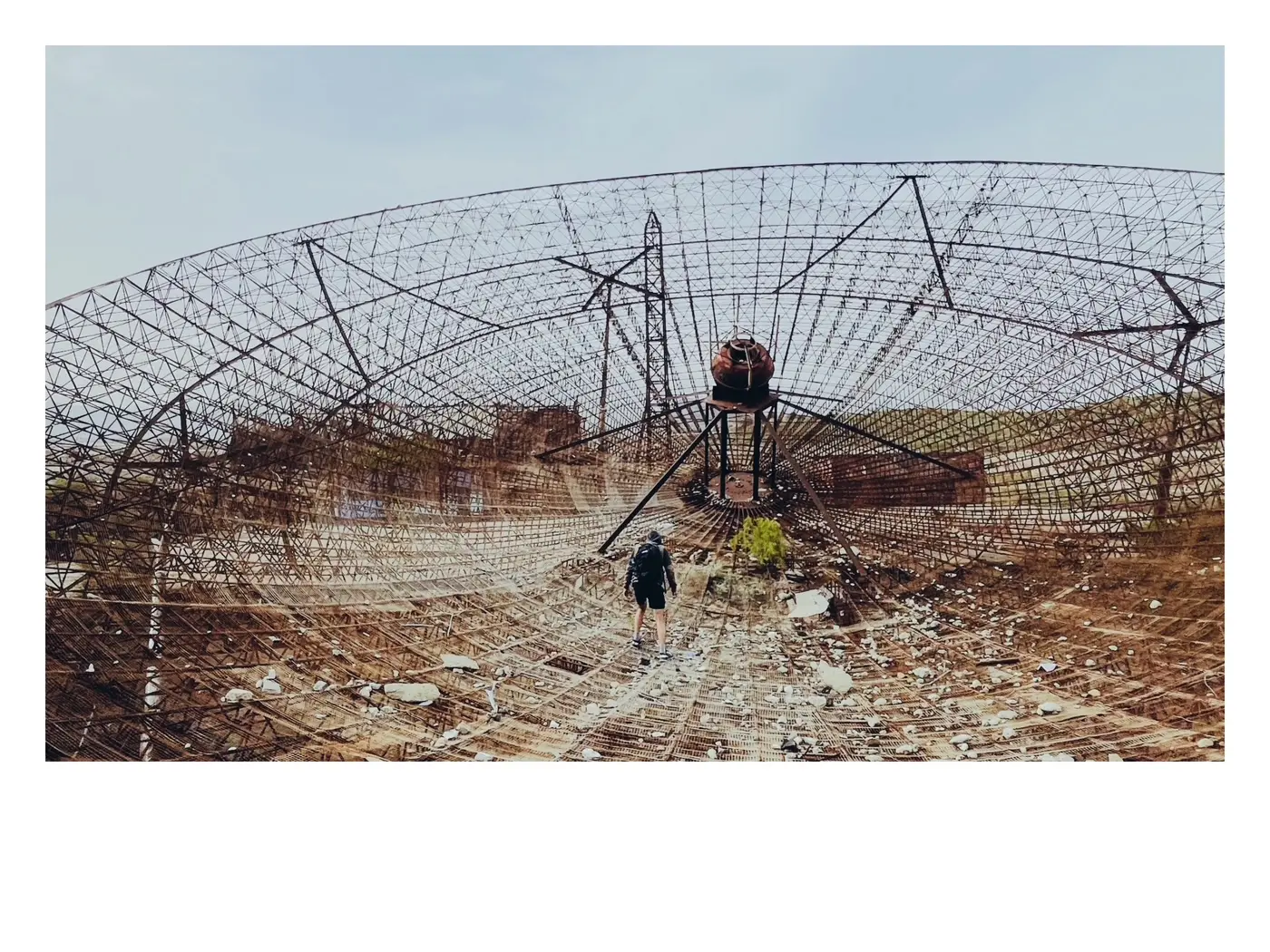
Matt is curious about the world. He quickly spotted an unusual object not far from town, standing in an almost complete wasteland, and started sending me photos. A huge, rusty structure, welded together from rebar, looked like an abandoned radio telescope. It was hard to guess what it was doing in a place like that. When I looked at the photos, I wanted to know too where it had come from.
After the move I came back to the subject. There was little information on the internet, but I learned that it was the remains of an experimental project using concentrated sunlight. The dish was meant to be a giant mirror. There was some interesting engineering behind it that I did not yet understand, and for a long time that was where my knowledge ended. Every time I saw that structure again, I wanted more and more to learn its history.
Two years have already passed since the move. I often went there, and since I am interested in absolutely everything a little bit, in astronomy since childhood, and radio came in a pair with electronics, suddenly an idea appeared (sit down): use this dish as a radio telescope - I wanted to check whether I could do it. And along the way show my sons that out of something old, potentially useless, looking like typical material for several dozen tonnes of razor blades, you can make a device with which we will try to receive a signal from space! An experiment like that, with no ambition of a scientific discovery - pure fun.
The plan assumed placing at the focus a receiving head tuned to about 1.420GHz, that is the frequency of the neutral hydrogen line known in radio astronomy. I wanted to receive the hydrogen signal in our Galaxy. According to press descriptions the dish is 26m in diameter. From its basic parameters I initially calculated that, assuming a parabolic shape (that is what I assumed at the time, I confirmed it later), the focus would fall roughly 8-9m from the centre of the dish, along its axis - that is exactly where the head with the radio receiver had to be placed. Many radio telescopes can be rotated and tilted to aim at a chosen fragment of the sky and then track it. I had to use the structure in its current, motionless position. The movement would be provided by the rotation of the Earth - that was my idea: successive areas of the sky would pass through the dish's field of view. I soon read that this even has its own name: drift scanning. I would of course be very limited, to just one strip of sky, but for this experiment it would be enough for me to register a clear hydrogen signal - and that was the point! I wanted to be able to say: it works.
With all this in my head, I had three main question marks:
- At such a tilt of the dish, will it be possible to receive any signal of the hydrogen line at all, which coincides with the plane of our galaxy? The position of Tenerife and the fixed angle of the dish did, however, raise my doubts.
- Will the mesh effectively reflect radio waves of this frequency? Its openings are about 2cm, and the length of this wave is about 21.1cm. I was afraid of losses connected with part of the radiation passing through the mesh. Because it is a bit like using wire fence mesh instead of a sheet metal satellite dish to receive a TV signal.
- And the worst thing, how to place the head 8-9m from the centre of the dish, exactly at the designated focus? There are some old masts and tall structures a few metres from the object, but none of them comes even close to the designated point in that strange space.
All of this required checking. I also considered other frequencies and observation targets, in case something thwarted the original plan. Later came the further question of the owner. The object looks abandoned, but after all it may belong to someone. On the site of the dish there is some shack and it seems someone lives there permanently. Would that person agree to make it available for the experiment? And does it belong to anyone at all?
The head itself I made fairly quickly from a biscuit tin lid and a piece of copper wire - for the first
start-up and tests it is quite enough.
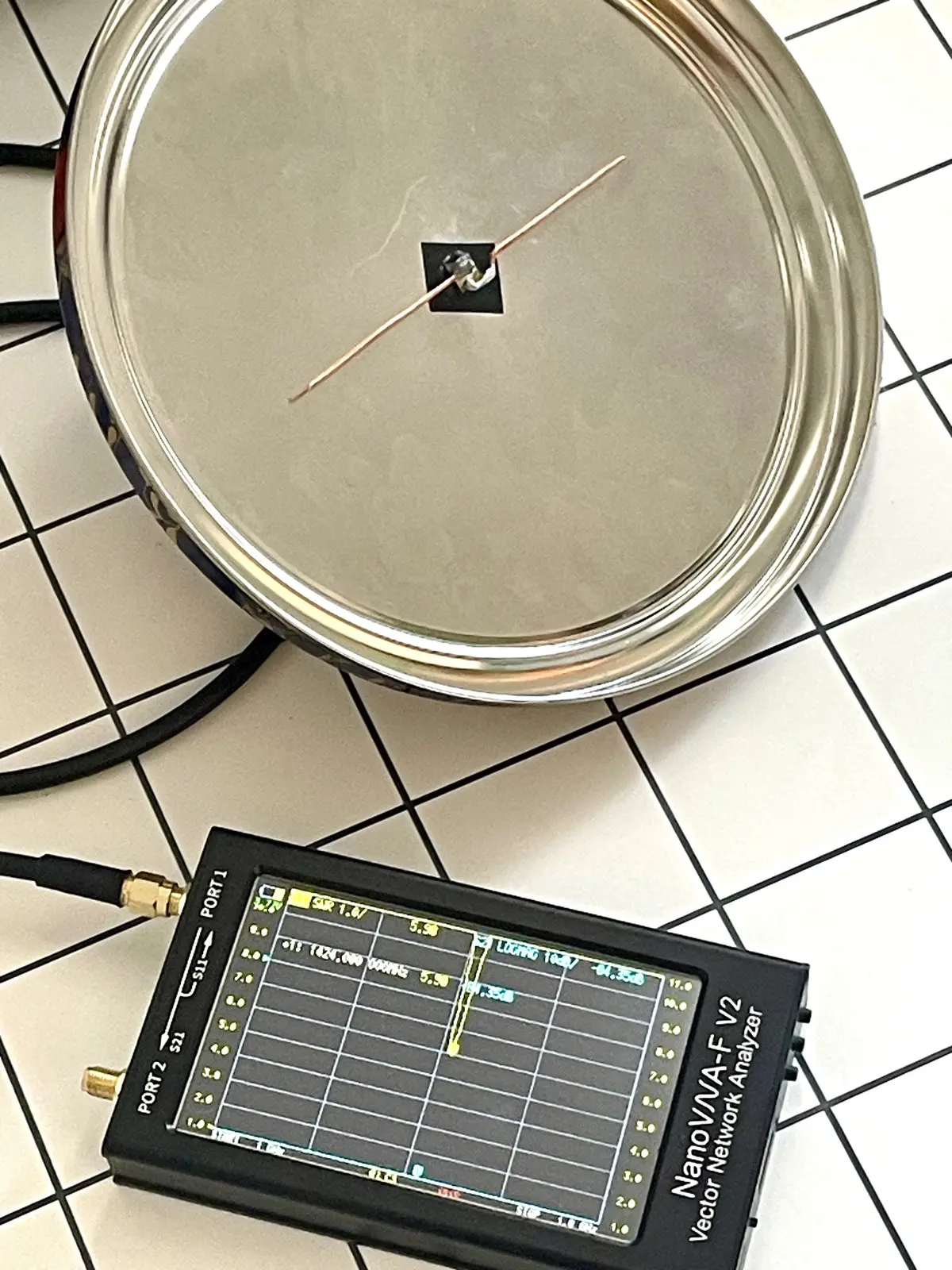
I have been interested in electronics since childhood and over the years I have gathered some equipment that I can reach for in the cupboard when the next idea comes to my mind. This time I pulled a NanoVNA out of the drawer - to put it simply, "a gizmo for antennas". So I had the preparation of the head behind me, but the way of mounting it was still going round in my head, and it was quite a challenge!
Months went by, and the sight of it fuelled my curiosity and reminded me almost daily about carrying out the idea and about the problem of mounting that damned head in a specific place in damned space. Finally the time came and I got down to preparations - I put other projects aside.
Preparations for carrying out the project? Hm...
I gathered everything that could help: technical descriptions, photos, information about elements that are missing today. I needed exact dimensions for the calculations, data allowing me to check the exact focal length, the tilt angle of the dish after the collapse of the actuators and load-bearing elements - that is the current state in which the dish rests today - and how to measure it in order to initially establish what the dish is staring at. I wanted to check at least roughly whether there is a chance of crossing the line of the Milky Way galaxy. I also wanted to establish whether the surface has the shape of a paraboloid or a section of a sphere, because that was not at all so obvious.
During these searches I quickly came across articles about the controversies surrounding the construction. Multi-million investments, promises of energy independence for the Canaries, protests from neighbours, patented technologies. Then lawsuits against the administration and claims reaching tens of billions of euros. On top of that inconsistent descriptions of the device, an astonishingly negligible amount of facts on the internet, no photos from the time the structure was being built, and successive versions of the technology which could not always be reconciled with each other. A bit of a perpetuum mobile, and a bit of a coil of wire. And everything led to the same rusty dish passed on walks. I very much wanted to understand the idea and the physics of this project, who designed all of it, what exactly he intended to achieve and how it ended up as what remains on Pelada today. With my growing fascination with this object, the radio telescope experiment faded into the background.
I decided to gather all the materials I managed to reach, put the history together into a whole and, having the object within arm's reach and the finds on the internet, try to explain a few contradictory pieces of information. Fairly quickly it turned out that one idea had become two separate stories. The first leads into the past, to Daniel González, his patents and the unfinished solar power plant. The second returns to the starting point: can something still be squeezed out of this lump of scrap iron and used as an experimental radio telescope? In the next two parts I will follow each of these roads separately.
In progress...
- part 02: The History of González and the Solar Power Plant
- part 03: The Experimental Radio Telescope - engineering the idea